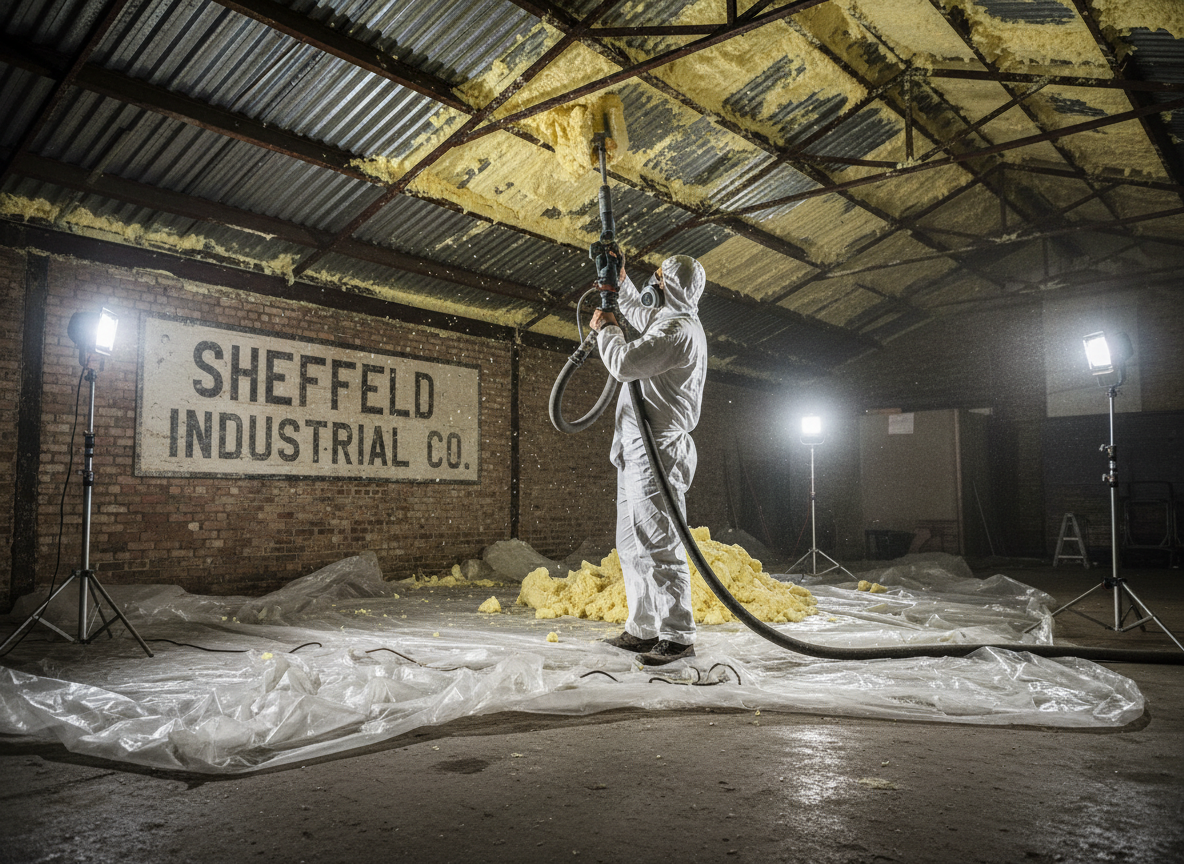
Commercial buildings in Sheffield often contain closed-cell spray foam applied decades ago in warehouse roofs and factory ceilings to combat the region's damp winters. Removing it requires careful separation from metal decking and concrete substrates without damaging structural elements or releasing particulates into ventilation systems. Crews must account for the dense packing in older industrial stock around the city centre and former steelworks sites where foam thickness can vary dramatically between bays.
Edge cases arise when foam has been installed over existing asbestos-containing materials common in pre-1980s Sheffield commercial properties. Proper containment and sequential layer removal prevent fibre disturbance while managing the heavy debris load that accumulates in multi-storey units. Local drainage patterns around the Don Valley also mean water ingress points must be sealed immediately after foam extraction to avoid corrosion on exposed steelwork.
Regulation compliance in South Yorkshire includes adherence to current building standards for re-insulation after removal, particularly where fire performance ratings are required in shared commercial spaces. Technicians inspect for hidden voids around service penetrations that can trap moisture once the foam is gone, a frequent issue in buildings with complex HVAC routes. Work is scheduled around operating hours to minimise disruption to tenants in active business parks.
Site-specific challenges include limited access in tight roof voids typical of Sheffield's converted mill buildings and the need for negative air machines to control dust migration into occupied areas below. Post-removal verification involves thermal imaging to confirm complete extraction before any new insulation is considered.
Technician insight
In Sheffield, the thing that catches most people out with Commercial Spray Foam Removal is how the hilly terrain funnels rainwater under roof edges on older industrial units, so the foam often hides rot in the decking that only shows once it's stripped away.
Sheffield warehouse roof clearance
A manufacturing unit near the canal had spray foam trapping condensation against the metal roof for years. We found widespread surface corrosion once the foam was removed. Extraction was completed over two nights using suspended access, followed by immediate corrosion treatment and sealing of all penetrations.
How it works
- 1
Site Assessment
Technicians inspect the commercial structure, identify foam type and depth, and map access points while checking for hidden hazards.
- 2
Containment Setup
Full negative pressure enclosures and dust extraction are installed to protect the workspace and adjacent areas.
- 3
Foam Extraction
Mechanical and manual methods remove the spray foam layer by layer, with debris collected for licensed disposal.
- 4
Substrate Inspection
Exposed surfaces are checked for damage, moisture, or remaining material before any repairs or sealing.
- 5
Final Clearance
Air quality testing and visual sign-off confirm the space is ready for re-occupation or further works.
Pricing
Cost depends on building size, foam depth, access difficulty and disposal volume; an on-site assessment provides the accurate figure.