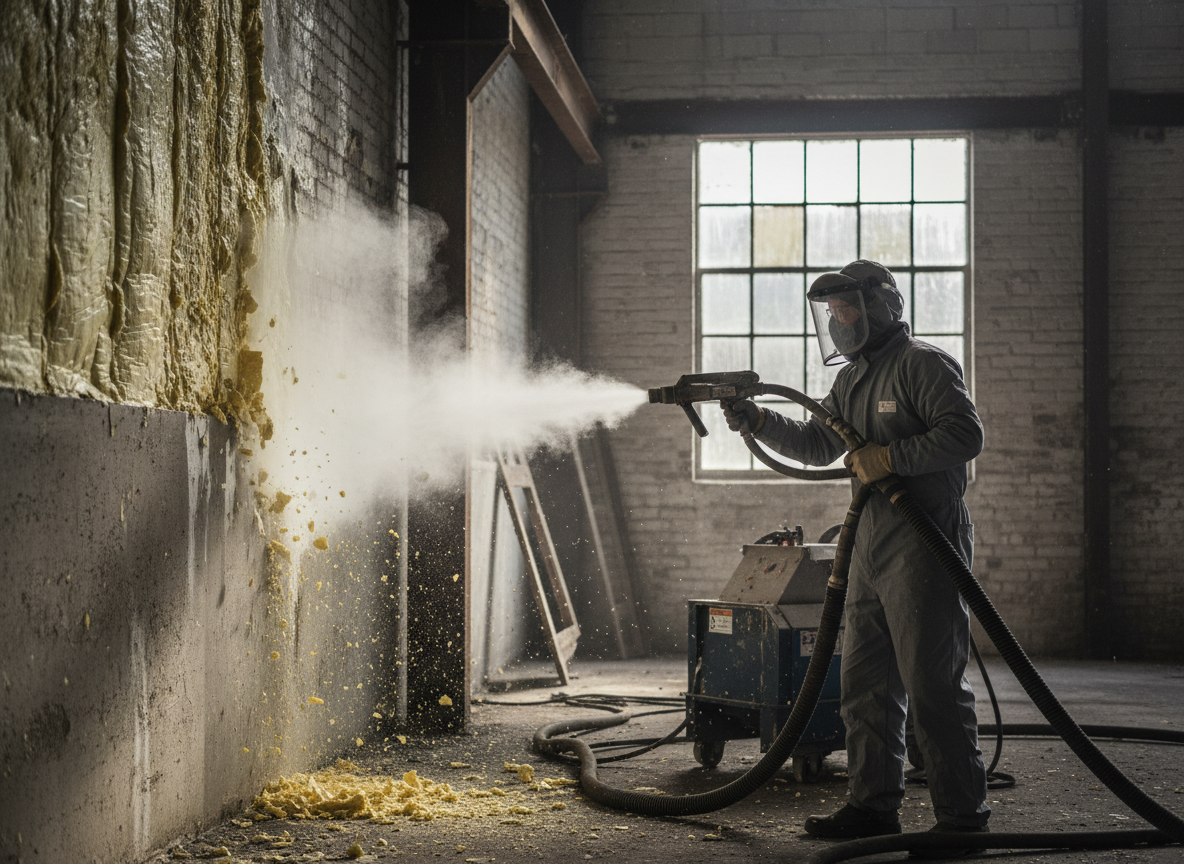
Dry ice blasting removes spray foam insulation by propelling solid CO2 pellets at high velocity, sublimating on contact to lift material without abrading underlying surfaces. In Sheffield’s Victorian and Edwardian terraces common in districts such as Walkley and Nether Edge, the method avoids damaging lath and plaster ceilings or timber joists that have settled over a century. Moisture trapped beneath foam often leads to hidden rot; the process reveals these areas immediately so repairs can be scheduled before re-insulation.
South Yorkshire’s frequent damp winters and driving rain against the Pennine slopes increase the risk of foam adhesion failure on north-facing roofs. Blasting crews must monitor substrate temperature closely because cold masonry can cause pellets to bounce rather than clean. Access through small loft hatches typical of Sheffield two-up two-downs requires sectional equipment and dust extraction to protect remaining fibreglass or mineral wool layers that many homeowners retain in adjacent bays.
Local building control officers increasingly flag non-breathable insulation during loft conversions. Dry ice blasting leaves no chemical residue, satisfying inspectors who require confirmation that original timber remains sound. The technique also works around electrical cables and pipework without the vibration risk of mechanical scraping, an important consideration in homes where 1970s-1980s foam upgrades were installed over knob-and-tube wiring still present in some Crookes and Broomhill properties.
Technician insight
In Sheffield, the thing that catches most people out with dry ice blasting spray foam removal is the combination of narrow terraced loft hatches and persistent Pennine damp that leaves foam bonded tightly to cold roof timbers; rushing the blast pressure here often leaves residue that later moulds.
Walkley Terrace Loft Clearance
Homeowner in a 1900s terraced house reported musty smells after heavy winter rain. Inspection found spray foam trapping moisture against rafters. Dry ice blasting cleared the foam without disturbing original laths. Airflow was restored and the loft dried out within a week.
How it works
- 1
Site Assessment
Technicians inspect loft access, foam depth, and any visible moisture or wiring before quoting.
- 2
Containment Setup
Plastic sheeting and HEPA extraction are installed to capture loosened foam and prevent dust migration into living spaces.
- 3
Dry Ice Blasting
Pellets are applied at controlled pressure, working methodically across rafters and between joists until foam is fully removed.
- 4
Final Clean and Inspection
Remaining residue is vacuumed and surfaces are checked for damage before equipment is removed.
Pricing
Upfront quotes issued after inspection; final cost depends on foam thickness, loft access and property size.